Oven Roasted Turkey

Updated Nov 03, 2026
This post may contain affiliate links. Please read our disclosure policy.

I’ll show you how to make a juicy oven-roasted turkey for Thanksgiving using my butter-soaked cheesecloth method! The cheesecloth helps keep the turkey moist as it roasts, while the skin turns beautifully golden. No brining needed, and I’ve included all my best tips for getting it right.

Easy Thanksgiving Turkey Recipe

I’m all about keeping Thanksgiving cooking as simple as possible, especially when it comes to the turkey! I’ve roasted plenty of turkeys over the years, and my favorite way to do it is with butter-soaked cheesecloth. I baste the turkey as it roasts, then remove the cheesecloth toward the end so the skin gets nice and crispy. It’s a method I keep coming back to because the turkey turns out juicy, buttery, and beautifully browned.
While the turkey roasts, I can start the rest of Thanksgiving dinner, including my cranberry sauce, easy pumpkin pie, and fluffy buttermilk mashed potatoes.

Why You’ll Love This Roasted Turkey Recipe
- Golden, crispy skin. My butter-soaked cheesecloth method, along with regular basting and a final uncovered roast, gives the turkey that beautiful golden skin while keeping the meat juicy.
- No brining. While you can absolutely brine your turkey for more flavor and juiciness, this beginner-friendly roasting recipe eliminates that extra step.
- Easy to follow. I’ve included step-by-step photos, roasting times, and my best tips to help you cook a juicy Thanksgiving turkey without the guesswork.
Ingredients for an Oven Roasted Turkey
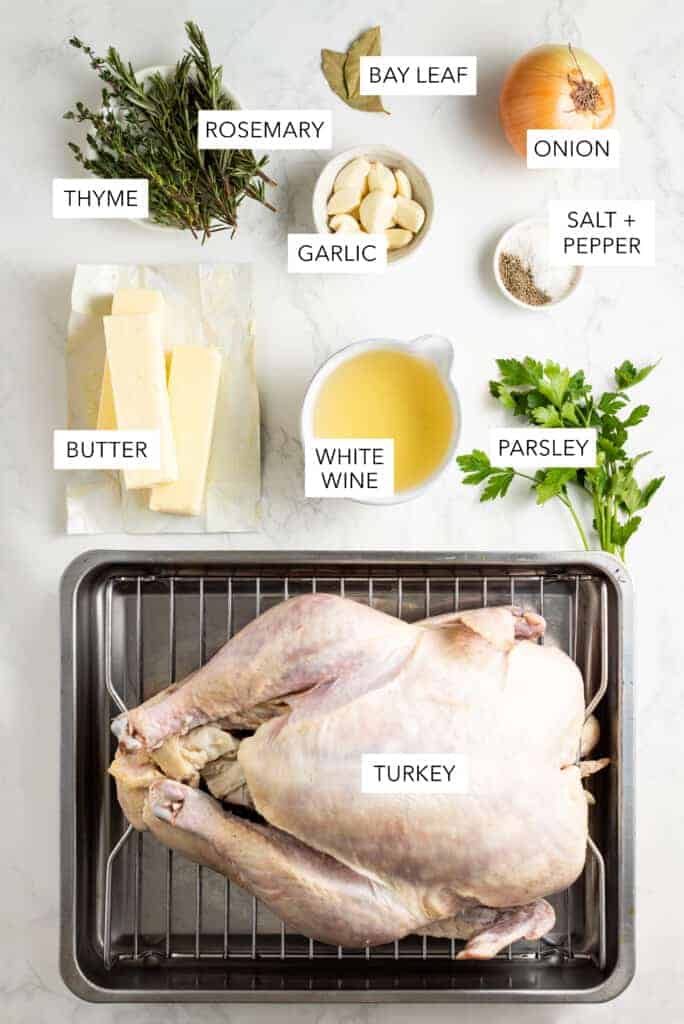

- Whole Turkey – For a typical Thanksgiving dinner, I plan for 1 to 1½ pounds of turkey per person (a 14-pound whole turkey will feed roughly 10-14 people). If your turkey is frozen, you’ll need to thaw it completely. This can take several days, so plan accordingly. See below for details.
- Yellow Onion – I love yellow onion for its sweetness, but feel free to use white onion or shallots as well.
- Garlic – Fresh garlic always yields the best flavor. However, you can swap it for ½ teaspoon of garlic powder per clove.
- Herbs – Fresh rosemary, thyme, and parsley sprigs, for stuffing the cavity. I also add a few bay leaves.
- Unsalted Butter – If you use salted butter, reduce the amount of salt in the rest of the recipe.
- Dry White Wine – My favorite is Chardonnay, but Sauvignon Blanc works well in the butter sauce, too. If you’d prefer to cook without wine, substitute chicken stock instead.
Step-by-Step: How to Roast a Turkey in the Oven
The key to a perfect roast turkey is proper prep. First, loosen the skin to help it crisp, then fill the turkey cavity with herbs and aromatics to flavor the meat from the inside out. Then roast it using the cheesecloth method, so your Thanksgiving turkey comes out super juicy, flavorful, and tender.


- Prep the oven. Preheat the oven to 450ºF, and position the rack in the lower third of the oven.
- Prepare the turkey. Remove the giblets and neck from the turkey (these will usually be inside the hole or “cavity”). If you’d like, you can save the giblets to flavor your turkey gravy later on. Then, use paper towels to pat the turkey dry.
- Loosen the skin. Carefully slide your fingers under the turkey skin to loosen it. Try not to tear or detach the skin completely. You can also use the long end of a wooden spoon for this.
- Fill the cavity. Season the turkey with salt and pepper, and place onions, garlic, rosemary sprigs, thyme sprigs, parsley, and bay leaves inside the cavity.
- Truss the turkey. Place the turkey on a roasting rack set inside a large roasting pan, breast side up. Use kitchen twine to tie the ends of the legs together. Tuck the wing tips back.
- Melt the butter. Meanwhile, heat the butter with wine in a saucepan over medium heat until it’s warm and melted.
- Prepare the cheesecloth. Fold the cheesecloth in half twice (it will have 4 layers). Using kitchen tongs, carefully lower the cloth into the melted butter. Once it has soaked up the butter mixture, remove the cloth and unfold it once.
- Cover the turkey. Now, place the cheesecloth on top of the turkey and smooth it out. Cover the leftover melted butter with a lid to keep it warm.
- Roast it. It’s time! Place your turkey in the oven. Roast for 30 minutes at 450ºF, then reduce the temperature to 350ºF. Continue to roast for 2 hours. Every 30 minutes, baste the cheesecloth and turkey with the remaining butter.
- Brown the skin. Carefully remove and discard the cheesecloth, then return the turkey to the oven, uncovered, for about 30 minutes, or until the skin is golden and crispy and the turkey reaches an internal temperature of 165°F.

Tips for the Perfect Thanksgiving Turkey
- Chill the turkey before roasting. Before roasting, let the turkey rest overnight in the fridge, loosely covered with foil. This helps the skin dry out and get extra crispy in the oven.
- Keep an oven-roasted turkey moist. Fill a baking dish with water and place it on the lowest rack in the oven. As the turkey cooks, the water will evaporate in the hot oven and create steam, helping keep your turkey juicy.
- Turn it around. Most ovens have hot spots. To prevent one side of your turkey from cooking properly while the other doesn’t, turn the roasting pan (with the turkey) halfway through cooking.
- Don’t skip the crisping step. Remove the cheesecloth and return the turkey to the oven, uncovered, for the final 30 minutes of roasting. It’s the secret to golden, crispy skin.
- Rest before carving. Once it’s out of the oven, allow the roasted turkey to rest at room temperature for 30 minutes, then carve it. This gives the juices a chance to redistribute throughout the meat.
- Add veggies. Chopping up baby potatoes, carrots, and other veggies will give you a 2-in-1 dinner of roasted veggies and turkey. Use them to make a bed for the turkey in the roasting pan.
- Use compound butter. Compound butter is a mixture of butter with herbs, spices, garlic, and other ingredients. It’s a great way to give the turkey extra flavor. You could also use my homemade garlic butter sauce in place of the melted butter and wine in this recipe.

What to Serve with Roasted Turkey
This oven roasted turkey pairs perfectly with classic Thanksgiving side dishes like these make ahead freezer mashed potatoes, stuffing, and green bean casserole. I love turning the leftover turkey pan drippings into gravy, and you can’t go wrong with fluffy dinner rolls to soak up the leftovers. This festive cherry pie is the best holiday dessert!
Frequently Asked Questions
Turkeys are roasted at both 450˚F and 350˚F. It should be roasted at 450˚F for the first 30 minutes and then at 350˚F for the remaining 2 hours and 30 minutes.
Both. The initial portion of roasting should happen with your turkey covered to keep the skin from browning too quickly and burning. Once the meat is almost fully cooked, it can be uncovered to crispen the skin and brown it.
Basting is the first secret to keeping an oven-roasted turkey moist. Baste every 30 minutes with the butter mixture and cooking juices to keep the turkey from drying out, and don’t overcook it. Turkey is done when its internal temperature registers 160ºF to 165ºF.
Plan for approximately 13 minutes of roasting time per pound of turkey. For example, I used a 14-pound turkey for this recipe, and it took about 3 hours to roast.
Keep in mind that roasting times are only estimates. For the safest results, use a meat thermometer to check that the turkey reaches 160˚F to 165°F in the thickest part of the breast, the innermost thigh, and the innermost wing. Then, remove it from the oven and let it rest for 30 minutes before carving.
A good rule of thumb is to budget 24 hours of thawing time in the fridge for every 4-5 pounds of turkey. So, a 14-pound turkey will need about 3 to 3½ days to thaw! Make sure to take your turkey out of the freezer in time.
Pin this now to find it later
Pin It
Oven Roasted Turkey
Ingredients
- 14 pound whole turkey, completely thawed
- 1 tablespoon salt, or to taste
- ½ tablespoon freshly ground black pepper, or to taste
- 1 large yellow onion, quartered
- 8 cloves garlic, crushed
- 6 rosemary sprigs, or 1 tablespoon dried rosemary
- 6 thyme sprigs, or 1 tablespoon dried thyme
- 6 parsley sprigs, or 1 tablespoon dried parsley
- 2 bay leaves
- 1½ cups unsalted butter
- 2 cups dry white wine, I use Chardonnay
Instructions
- Prepare for roasting. Preheat the oven to 450°F with an oven rack placed in the lower third. Place a roasting rack in a large roasting pan. Set aside.
- Prep the turkey. Remove giblets and neck from turkey; reserve for later to make turkey broth, or discard them. Pat the turkey dry with paper towels.
- Loosen the skin. Starting at the neck end, loosen the skin from the breast by inserting your fingers or a long stick (I use my wooden spoon) and gently pushing between the skin and the meat. Do not detach the skin completely.
- Season the turkey. Season the turkey all over with salt and pepper; season the cavity, too. Place onions, garlic, rosemary sprigs, thyme sprigs, parsley, and bay leaves inside the cavity.
- Truss the turkey. Tie the ends of the legs together with kitchen twine, and tuck the wing tips behind the back. Place the turkey on the rack in the roasting pan, breast side up, and set aside.
- Melt the butter. Add butter and white wine to a medium saucepan; cook over medium heat, stirring occasionally, until the butter is melted and the mixture is warm. Remove from heat.
- Soak the cheesecloth. Take the cheesecloth and fold it in half two times so you get 4 layers. Using a pair of tongs, lower the cheesecloth into the butter mixture to absorb it. Then, remove the cheesecloth and unfold it once, so you end up with two layers.
- Cover the turkey. Place the cheesecloth on top of the turkey to cover it; smooth out the cheesecloth onto the turkey’s skin. Cover the remaining butter mixture to keep it warm.
- Roast. Roast the turkey for 30 minutes at 450˚F. Then, reduce the oven temperature to 350°F, and roast for 2 hours, basting the cheesecloth and any exposed areas of the turkey every 30 minutes with the reserved butter mixture.
- Remove the cloth. Remove the roasting pan from the oven and peel away the cheesecloth, being careful not to tear the skin. Discard the cheesecloth.
- Crisp up the skin. Continue to roast the turkey (and baste it) for about 30 more minutes or until the skin is browned and a thermometer inserted into the thickest portion of the breast registers at 160˚F.
- Rest and carve. Remove the turkey from the oven and let it rest for 30 minutes before carving and serving.
Notes
- Juicy Turkey: There are many ways to ensure your turkey does not dry out. One of them is to take the turkey out of the oven as soon as the internal temperature registers at 160˚F. Also, you can create steam by filling a baking dish with water and placing it on the lowest rack in the oven. Finally, turn the roasting pan around halfway through cooking to avoid one side of the turkey cooking properly but not the other.
- Basting the Turkey: Basting is an excellent way to moisten the turkey. Baste the turkey every 20 or 30 minutes of roasting time with the butter mixture plus the cooking juices to keep your turkey from drying out.
- Cover the Turkey: For other recipes that do not use cheesecloth, you should cover the turkey with foil to keep the skin from browning too quickly. Then, uncover it about 30 minutes before it is cooked so the skin can brown and crisp up.
- Cooking Time: This will depend on the size of the turkey, but the rule of thumb is to cook the turkey for 13 to 14 minutes per pound.
Nutrition
Nutritional info is an estimate and provided as courtesy. Values may vary according to the ingredients and tools used. Please use your preferred nutritional calculator for more detailed info.
How to Store and Reheat Leftover Turkey
- Refrigerate. Refrigerate any cooled and sliced leftovers in an airtight container for 3 to 4 days. You can also cover the roasting pan with foil and refrigerate the leftover turkey whole. I love using leftover turkey in turkey salad sandwiches and turkey chili.
- Reheat leftovers. To reheat it, sprinkle it with a few teaspoons of water and then microwave it for up to 2 minutes or until warm. You can also reheat it in a pan over medium heat until heated through.
- Freeze. Carve the turkey and wrap the pieces once in foil, then in plastic wrap twice. Transfer it to a freezer-friendly bag or container and freeze it for up to 3 months. Move the turkey to the fridge a day before serving it so it has enough time to thaw.








This looks absolutely amazing! I love the flavors. You can’t beat a perfectly cooked turkey.
Thank YOU! I hope you enjoy it! 🙂